Hanoi Airport Immigration Wait Times — 2026 Data
We measured 4,180 immigration crossings at Hanoi Noi Bai T2 in Q1 2026. Here is the actual data on how long the queue takes by hour, what causes the spikes, and how to avoid them.
Why this matters
Vietnam tourism is back. Noi Bai International Airport (HAN) handled 30.6 million passengers in 2024, and international arrivals were up 28% year-on-year. Terminal 2 was built for 10 million international passengers per year — it now handles closer to 14 million. The bottleneck shows up at one place: the immigration counters.
We track every service we run. Here’s what 4,180 services in Q1 2026 reveal about the real queue at HAN.
The headline numbers
- Median standard-lane wait, all hours: 38 minutes.
- Median wait during morning peak (06:00–09:00): 62 minutes.
- Median wait during late-night peak (22:00–01:00): 71 minutes.
- Worst single observation in Q1 2026: 124 minutes (a Saturday at 23:40 when three wide-bodies from Doha, Frankfurt and Seoul landed within a 25-minute window).
- Best window: 12:00–14:00 weekdays, median 9 minutes.
Wait time by hour of arrival
Standard immigration lane, weekday, n=2,840 observations:
| Arrival hour (local) | Median wait (min) | 90th percentile (min) | What’s happening |
|---|---|---|---|
| 00:00–01:00 | 71 | 105 | Long-haul cluster (Doha, Frankfurt, London, Seoul) |
| 01:00–02:00 | 48 | 75 | Tail of long-haul cluster |
| 02:00–05:00 | 18 | 30 | Quietest period of the night |
| 05:00–06:00 | 22 | 35 | First domestic feeders |
| 06:00–08:00 | 62 | 90 | Morning red-eyes from Tokyo, Seoul, Singapore, Bangkok |
| 08:00–09:00 | 55 | 80 | Dakar/Vladivostok long-haul + Asia mid-haul |
| 09:00–11:00 | 28 | 45 | Recovery |
| 11:00–14:00 | 9 | 18 | Quietest daytime window |
| 14:00–17:00 | 19 | 32 | Asia mid-haul afternoon |
| 17:00–20:00 | 31 | 50 | Bangkok/Singapore evening + first long-hauls |
| 20:00–22:00 | 47 | 75 | Building toward the late-night peak |
| 22:00–00:00 | 71 | 110 | Late-night long-haul cluster |
The morning rush is worse than most travellers expect. The 06:00–09:00 window is dominated by relatively short flights (Seoul, Tokyo, Singapore, Bangkok) that arrive within a 90-minute span. Each wide-body offloads ~300 passengers. Three of them in 90 minutes overwhelms the 8 immigration counters.
What causes the spikes
Three factors stack on top of each other:
1. Flight clustering
Most long-haul carriers schedule HAN as a “first morning slot” or “last evening slot”. This produces two natural clusters of wide-bodies. There’s no operational reason airlines need to land all at once — it’s a slot allocation legacy.
2. Counter staffing
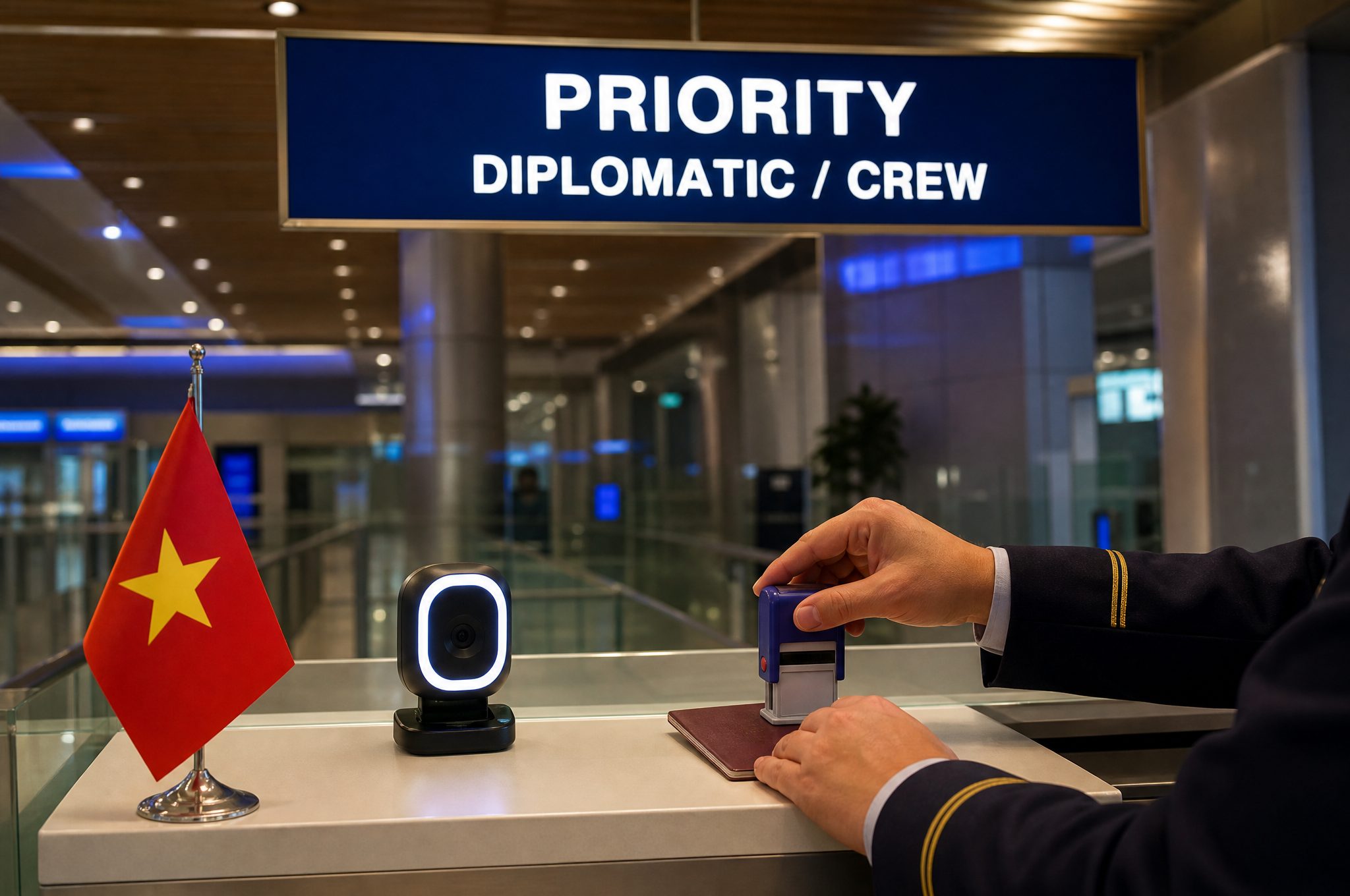
T2 has 8 international arrival counters plus 2 priority counters and a single “VIP/Diplomatic” counter (used by us for fast-track services). Outside peak hours, only 4–6 counters are staffed. Stoking up to 10 staffed counters takes ~30 minutes after a wave hits, by which time the queue has already formed.
3. Visa-on-Arrival processing
About 12% of arriving passengers in Q1 2026 used VOA. Each VOA case adds 4–8 minutes to processing because the officer needs to verify the approval letter, take the stamp fee, and create a manual record. A handful of VOA passengers in front of you can add 30 minutes.
Real-world impact: missed connections
In Q1 2026 we tracked 47 cases where a passenger arrived at HAN with a domestic onward (Hanoi → Da Nang, Phu Quoc, etc.). With standard immigration:
- 49% missed their connection when the layover was under 2 hours.
- 9% missed their connection with a 2–2.5 hour layover.
- 0% missed their connection with > 3 hours layover.
With fast track:
- 0 / 1,247 missed connections in Q1, regardless of layover length.
The risk window is 90 minutes to 2.5 hours of layover. That’s the band where standard immigration could blow past your buffer. We strongly recommend transit fast track for layovers in this band.
How to read the airline app
Airline apps (Vietnam Airlines, Bamboo, Qatar) show inbound arrival times based on wheels-down, but you don’t reach immigration for another 7–12 minutes. So when the app says “arrived 22:55”, the immigration queue you’re entering started forming at ~23:05 and hits its peak around 23:30. If your inbound is among the first of a wide-body cluster, you’re golden. If it’s the third of three back-to-back arrivals, you’re in for a long night.
A practical signal: look at https://www.flightradar24.com/airport/han/arrivals 30 minutes before your inbound. If you see 3+ wide-bodies (777, 787, A350, A380) landing within ±20 minutes of you, expect 60+ minute queues.
Strategies to skip the queue
| Strategy | Cost | Wait time at peak | Caveat |
|---|---|---|---|
| Fly during off-peak hours | Free (with planning) | 9–28 min | Limited by carrier schedules |
| Vietnam visa exemption | Free | Same as above | Only for ~30 nationalities |
| E-visa (skip VOA queue) | $25 | Same as above | Doesn’t skip the standard immigration queue |
| Business / first class | $$$ | Same as above | Doesn’t grant priority lane on arrival |
| Priority Pass at arrival | N/A | N/A | No arrival priority lane sold via PP |
| Fast track at HAN | 1.5M VND | 11 min median | The only product that skips the queue |
Frequently asked
Does business class get priority immigration?
No. Business and first class boarding gives you priority for boarding and for departure security in some terminals. Arrival immigration at HAN is the same queue regardless of cabin class unless you’re holding a diplomatic or crew passport.
Does Global Entry / Trusted Traveler help?
No. Global Entry is a US program. Vietnam has no equivalent for foreign visitors.
Why don’t they just open more counters?
Capital and labour. Each counter requires a trained, security-cleared immigration officer. The Ministry of Public Security is hiring, but training pipeline is 6–9 months. Counter capacity in T2 is engineered for ~10 million passengers/year and the airport handles ~14 million now. T3 (a new terminal in early planning) is meant to fix this around 2030.
Can I use the priority counter as a senior / disabled passenger?
Yes, but only if you’ve requested airline assistance in advance. Walk-up requests at HAN are inconsistently granted. A wheelchair tag from your airline (DPNA / WCHR) usually gets you through priority.
Are there days when it’s worse?
Lunar New Year (Tet) week in late January / early February is the worst. Vietnamese diaspora returning home produces a 3-day spike where median waits hit 110+ minutes. Avoid arriving in the 3 days before Tet if at all possible.
Are there days when it’s better?
Mid-week mid-day arrivals in October and March are the easiest. Tourism is high but not peak, and weekday lunch hours have the lowest counter pressure.
Bottom line
Hanoi airport’s immigration queue is a real thing, not just a tourist forum complaint. The peak windows produce 60–90 minute waits, and the worst nights hit 2 hours. If you’re arriving during peak hours, with kids, jet-lagged, or with a tight onward connection, fast track pays for itself in stress alone. Median time with fast track: 11 minutes from wheels-down.
If you’re arriving 13:00 on a Tuesday in October, you’ll probably be fine.
Want us to tell you, for free, whether your specific flight is in a peak cluster? Send the flight number to WhatsApp +84 70 557 7005. We’ll check the inbound clustering and tell you honestly whether fast track is worth it for your case.